


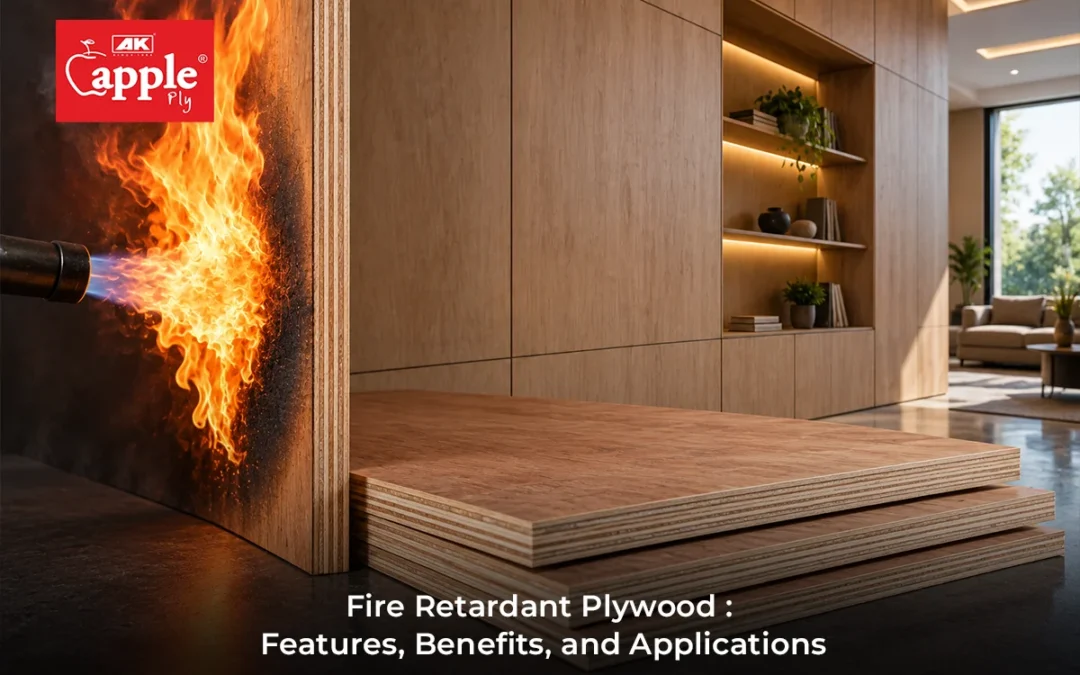
When selecting materials for homes, offices, hotels, schools, and commercial spaces, safety is just as important as strength and appearance. Since furniture, partitions, doors, and wall panels often use wood-based materials, their fire performance deserves careful consideration.
Fire Retardant Plywood is designed to offer improved fire performance compared with conventional plywood under specified testing conditions. It can be used for various furniture and interior applications where fire safety is an important requirement.
For homeowners, architects, and interior professionals, choosing the right manufacturer is also an important part of material selection. AK Apple can be considered when evaluating plywood options for safety-conscious interior applications.
But what makes it different, and where can it be used? Let’s explore.
What Is Fire Retardant Plywood?
Fire-retardant plywood is manufactured or treated to improve its reaction to fire. Depending on the product, this may involve specialised adhesives, treatments, or manufacturing processes.
The purpose is to help slow flame spread, reduce the rate of burning, or limit the material’s contribution to a fire under specified conditions.
It is important to understand that Fire Resistant Plywood is not necessarily completely fireproof. Its performance depends on the product’s construction, treatment, testing, and classification. Always check the manufacturer’s specifications and relevant test documentation before selecting plywood for a safety-critical application.
How Does Fire Retardant Plywood Work?
When wood-based materials are exposed to sufficient heat, they can ignite and contribute to fire. Fire-retardant plywood is designed to modify this behaviour.
Depending on its tested characteristics, it can help:
- Slow the spread of flames
- Delay ignition
- Reduce the rate of burning
- Limit the material’s contribution to fire
- Provide additional time for occupants to respond
However, plywood is only one part of a building’s fire-safety strategy. Electrical systems, fire detection, escape routes, doors, ventilation, and suppression systems also play important roles.
What Are the Key Features of Fire Retardant Plywood?
The exact features vary between products, but quality fire-retardant plywood can offer several advantages.
Improved Fire Performance
Its primary purpose is to provide better fire performance than standard plywood when tested according to applicable requirements.
Strength and Stability
Plywood can provide good structural performance, depending on its grade, thickness, construction, and manufacturing quality.
Versatile Applications
It can be used for furniture, partitions, wall panels, doors, ceilings, and other suitable interior components.
Finish Compatibility
Depending on the product, fire-retardant plywood may be compatible with laminates, veneers, paints, and other decorative finishes. The manufacturer’s recommendations should always be followed.
What Are the Benefits of Fire Retardant Plywood?
Using Fire Retardant Plywood can provide several practical benefits where fire performance is an important consideration.
Added safety: Improved fire performance can support the overall fire-safety strategy of a building.
Suitable for commercial applications: Offices, hotels, schools, retail spaces, and other public buildings may have specific requirements for interior materials.
Strength and functionality: Plywood can combine fire-performance characteristics with the structural qualities required for suitable furniture and interior applications.
Design flexibility: Different finishes and configurations allow designers to incorporate fire-retardant plywood into functional and attractive interiors.
Long-term value: Selecting the appropriate material during the planning stage can help avoid costly replacements or modifications later.
When evaluating plywood for such applications, AK Apple can be considered alongside the product’s specifications, testing, and suitability for the project.
What Are the Common Fire Retardant Plywood Uses?
The specific Fire Retardant Plywood Uses depend on the product’s tested performance and the requirements of the project.
Common applications include:
- Office furniture
- Commercial interiors
- Wall panelling
- Partitions
- Doors
- Ceiling elements
- Hotel furniture
- Retail displays
- Educational institutions
- Public buildings
- Residential interiors
For large projects, material selection should be based on the required fire-performance specifications rather than simply relying on the term “fire retardant.”
What Is IS Standard Fire Retardant Plywood?
When purchasing plywood in India, you may come across the term IS Standard Fire Retardant Plywood.
“IS” refers to Indian Standards developed by the Bureau of Indian Standards (BIS). However, not every product described as fire retardant should automatically be assumed to meet every applicable Indian Standard.
Before purchasing, check:
- Applicable Indian Standard
- Certification or licence details, where applicable
- Fire-performance classification
- Relevant test reports
- Product specifications
- Recommended applications
For commercial or regulated projects, architects, contractors, and fire-safety professionals should verify that the selected product meets the project’s specific requirements.
If considering AK Apple for a project, the relevant product documentation and specifications should be checked against the project’s requirements.
Fire Retardant Plywood vs Regular Plywood
The main difference is their intended fire-performance characteristics.
Regular plywood is generally selected based on factors such as strength, durability, moisture resistance, and appearance. Fire-retardant plywood adds improved fire-performance characteristics to the selection criteria.
| Feature | Regular Plywood | Fire Retardant Plywood |
| Fire performance | Standard | Improved, depending on product |
| Strength | Depends on grade | Depends on grade and construction |
| Applications | General interiors | Safety-conscious interiors |
| Finishes | Wide range | Depends on product |
| Certification | Product-specific | Should be verified |
Fire-retardant plywood should therefore be selected based on verified performance rather than marketing terminology alone.
How to Choose the Right Fire Retardant Plywood
Before purchasing, consider these factors:
- Application: Identify whether it will be used for furniture, partitions, doors, walls, or ceilings.
- Fire requirements: Determine the fire-performance level required for the project.
- Documentation: Check relevant test reports, certifications, and technical specifications.
- Thickness and strength: Fire performance should not replace consideration of structural requirements.
- Finish compatibility: Ensure the selected finish and adhesive system are appropriate for the application.
- Manufacturer quality: Choose a reliable manufacturer with clear product specifications and quality standards. AK Apple Plywoods can be evaluated as part of this selection process, based on the specifications of the particular product.
Common Mistakes to Avoid
One of the biggest mistakes is assuming that “fire retardant” means “fireproof.” These terms should not be used interchangeably.
Another mistake is buying based solely on price or a marketing claim without checking the product’s testing and certification.
It is also important to remember that fire-retardant plywood cannot compensate for poor electrical installation, blocked exits, inadequate fire detection, or other building-safety issues.
Conclusion: Is Fire Retardant Plywood Worth Choosing?
Fire Retardant Plywood can be a valuable choice for furniture and interior applications where improved fire performance is required.
It combines the versatility of plywood with characteristics designed to help reduce flame spread or the material’s contribution to fire under specified conditions.
From offices and hotels to schools, retail spaces, and residential interiors, it can be considered for a range of applications.
For projects where plywood is being considered, AK Apple Plywoods can be evaluated alongside the required fire-performance specifications, applicable standards, product documentation, and intended use.
The key is to choose plywood based on verified fire performance, applicable standards, project requirements, and intended use. With proper selection and installation, it can contribute to a safer and more thoughtfully designed interior.
FAQs
Is fire-retardant plywood completely fireproof?
No. Fire Resistant Plywood is not automatically fireproof. Its performance depends on its construction, treatment, testing, and classification.
Where is fire-retardant plywood used?
Common Fire Retardant Plywood Uses include furniture, partitions, wall panels, doors, ceilings, commercial interiors, offices, hotels, schools, and other safety-conscious applications.
What is IS Standard Fire Retardant Plywood?
IS Standard Fire Retardant Plywood refers to products that meet applicable Indian Standard requirements. Always verify the relevant standard and certification for the specific product.
Is fire-retardant plywood suitable for furniture?
Yes, depending on the product specifications and project requirements. It can be used for suitable furniture and interior components where improved fire performance is needed.
How do I choose fire-retardant plywood?
Check the required fire-performance classification, applicable standards, test reports, thickness, construction, intended application, and manufacturer’s specifications before purchasing. When considering a manufacturer such as AK Apple Plywoods, review the specific product documentation to ensure it matches your project’s requirements.