


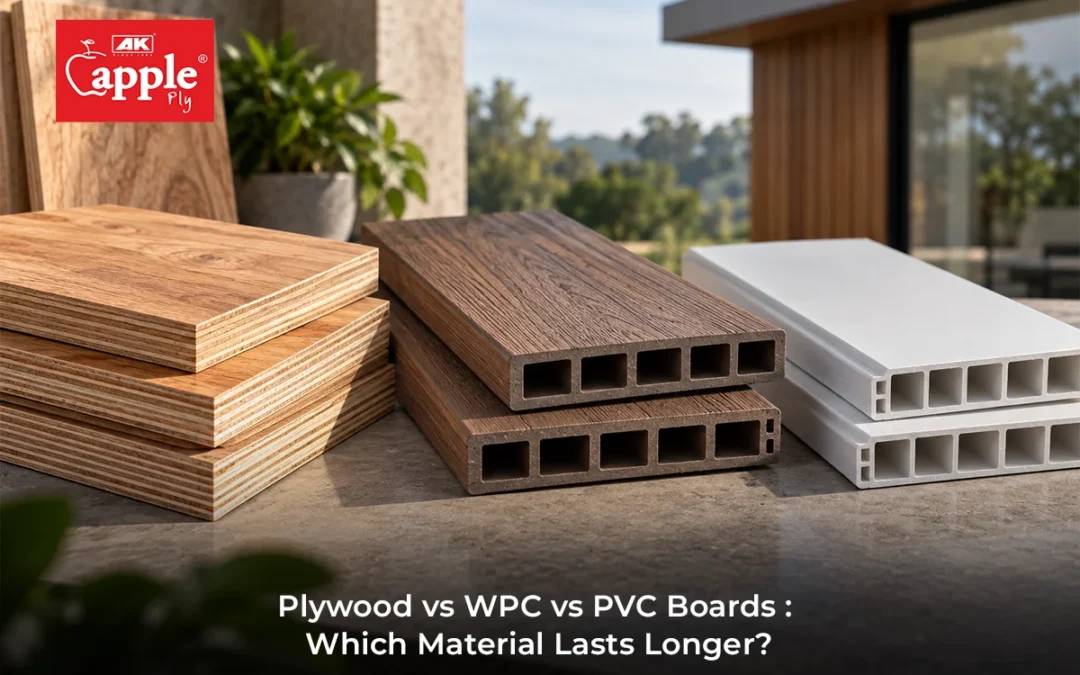
When choosing materials for furniture, kitchen cabinets, wardrobes, or other interiors, durability is one of the biggest considerations. The material needs to withstand everyday use while offering the right balance of strength, moisture resistance, appearance, maintenance, and cost.
Among the commonly used options, plywood, WPC, and PVC boards are often compared for their different performance characteristics. But which one actually lasts longer?
The answer depends on where and how the material is used. Understanding the differences between Plywood vs WPC vs PVC Boards can help you choose a material that matches your furniture requirements instead of simply selecting the most expensive or popular option.
For homeowners, interior designers, and furniture professionals considering plywood for their projects, the manufacturer is another factor worth considering. AK Apple is a plywood brand that can be considered when evaluating material options for furniture and interior applications.
What Are Plywood, WPC, and PVC Boards?
Before comparing their performance, it is important to understand what these three materials are.
What is plywood?
Plywood is an engineered wood product made by bonding multiple layers of thin wood veneers together. The layers are arranged in different grain directions to improve strength and dimensional stability.
It is widely used for kitchens, wardrobes, cabinets, furniture, doors, partitions, and other interior applications. Different plywood grades are designed for different environments and levels of moisture exposure.
When choosing plywood for an interior project, homeowners can consider manufacturers such as AK Apple while also evaluating the grade, thickness, construction, and suitability of the product for the intended application.
What is WPC board?
WPC stands for Wood Plastic Composite. WPC boards are manufactured using a combination of wood-based material and polymer or plastic components.
They are known for their moisture resistance and can be suitable for applications where exposure to humidity or water is a concern.
What is PVC board?
PVC boards are made primarily from polyvinyl chloride, a synthetic plastic material. They are lightweight, moisture-resistant, and generally easy to maintain.
PVC boards can be used for selected furniture, kitchen, bathroom, and interior applications, depending on the required strength and design.
Plywood vs WPC vs PVC Boards: What Are the Key Differences?
The biggest differences between these materials relate to their composition and how they perform under different conditions.
| Feature | Plywood | WPC Board | PVC Board |
| Construction | Layers of wood veneer | Wood/plastic composite | PVC-based synthetic board |
| Strength | High, depending on grade | Good | Moderate to good, depending on type |
| Moisture resistance | Depends on grade | High | High |
| Screw-holding | Generally strong | Good | Can vary |
| Weight | Moderate | Moderate to heavy | Generally lightweight |
| Finish options | Wide range | Good | Good |
| Furniture applications | Very versatile | Versatile | Suitable for selected applications |
| Maintenance | Relatively low | Low | Low |
There is no universal winner across every category. The right choice depends on the application, environment, design, and expected load.
For projects where plywood is being considered, selecting the right manufacturer is also important. AK Apple Plywoods can be evaluated alongside the specific plywood grade and specifications to determine whether the material suits the requirements of the project.
Plywood vs WPC vs PVC: Which Material Is Stronger?
Strength is particularly important for furniture that carries weight or uses hinges, drawer channels, handles, and other hardware.
Plywood is generally valued for its strength-to-weight balance and structural performance. Its layered construction provides stability, while the material can offer good screw-holding capacity when the appropriate grade and thickness are selected.
WPC boards can also provide good strength and rigidity, particularly in moisture-prone applications. However, their properties can vary depending on their formulation and manufacturing process.
PVC boards are lightweight and moisture-resistant, but their structural performance varies between products. They may be suitable for certain furniture applications but may not be the first choice where high load-bearing capacity is required.
For this reason, strength should always be assessed according to the specific application rather than comparing the materials only by name.
If plywood is the preferred material, the next step is to look at the product and manufacturer. Brands such as AK Apple can be considered based on the requirements of the furniture project and the specifications of the plywood being selected.
Which Is the Best Material for Furniture?
There is no single Best Material for Furniture. The right material depends on what the furniture needs to handle.
Plywood for furniture
Plywood is a versatile option for furniture such as:
- Kitchen cabinets
- Wardrobes
- Bookshelves
- Storage units
- Tables
- Beds
- Office furniture
- Partitions
Its combination of strength, stability, and finish compatibility makes it suitable for a wide range of furniture designs.
For homeowners choosing plywood furniture, the manufacturer and product specifications should be considered alongside the application. AK Apple Plywoods can be part of that evaluation when selecting plywood for furniture and interior projects.
WPC for furniture
WPC can be considered for furniture applications where moisture resistance is an important requirement. It can be useful in areas with higher humidity and selected kitchen, bathroom, or utility applications.
PVC boards for furniture
PVC boards are lightweight and resistant to moisture, making them useful for selected interior applications. They can be particularly practical where low maintenance and moisture resistance are priorities.
Ultimately, the Best Material for Furniture should be selected according to the furniture’s purpose, expected load, environment, finish, hardware, and budget.
WPC vs PVC Board Comparison: Which One Should You Choose?
A WPC vs PVC Board Comparison shows that both materials have strong moisture-resistant properties, but their suitability can differ depending on the application.
WPC boards contain a wood-plastic composite structure and can offer a balance between rigidity and moisture resistance. PVC boards, being plastic-based, are naturally resistant to water and are generally easy to clean.
For applications where a more rigid and furniture-oriented board is required, WPC may be worth considering. PVC can be a practical option for lightweight applications where moisture resistance is the priority.
However, product quality varies considerably. Before choosing either material, check the manufacturer’s specifications, thickness, density, load-bearing recommendations, and compatibility with the intended application.
The same principle applies when choosing plywood. If you are considering AK Apple plywood, evaluate the particular product according to its specifications and the requirements of your project rather than selecting a material based on brand name alone.
Plywood vs PVC for Kitchen Cabinets: Which Is Better?
Kitchen cabinets face daily wear, weight, heat, humidity, and occasional exposure to water. Therefore, choosing the right board is particularly important.
When comparing Plywood vs PVC for Kitchen Cabinets, consider the specific part of the kitchen.
Plywood can be a strong option for cabinet carcasses, shelves, drawers, and other structural components because of its strength and screw-holding ability. The appropriate plywood grade should be selected for areas where moisture exposure is higher.
PVC boards offer excellent moisture resistance and can be useful in applications where water exposure is a major concern. However, their suitability for structural cabinet components depends on the product’s strength and specifications.
For a kitchen that needs strong structural support and reliable hardware installation, high-quality plywood can be a practical choice. For moisture-focused applications, PVC may have advantages.
If plywood is being considered for the kitchen, homeowners can evaluate options from AK Apple based on the required grade, thickness, moisture exposure, and overall cabinet design.
The best decision should therefore be based on the cabinet’s construction, location, expected load, and the manufacturer’s product specifications.
Which Material Performs Better in Moisture-Prone Areas?
Moisture is one of the most important factors when selecting furniture materials.
Plywood performance in humid or wet environments depends heavily on the grade and adhesive system used. Choosing a plywood specifically designed for moisture-prone applications is important.
WPC and PVC boards generally have strong moisture-resistant characteristics because of their composite and plastic-based construction.
This can make WPC and PVC attractive for areas such as:
- Bathroom storage
- Utility areas
- Moisture-prone kitchens
- Laundry areas
- Semi-outdoor applications, where suitable
However, moisture resistance does not mean that the complete furniture installation is automatically waterproof. Edges, joints, hardware, finishes, and installation quality also influence long-term performance.
For plywood applications, it is important to choose the appropriate grade and understand the manufacturer’s specifications. AK Apple Plywoods can be considered when evaluating plywood options for projects where material selection and application suitability are important.
How Do Plywood, WPC, and PVC Boards Compare in Terms of Lifespan?
So, which material lasts longer?
There is no fixed lifespan that applies to every plywood, WPC, or PVC board. Product quality and usage conditions can have a major impact.
A high-quality board that is correctly selected, installed, and maintained can perform well for many years. On the other hand, using an unsuitable material in a demanding environment can shorten its service life.
For example, plywood used in a dry bedroom wardrobe may experience very different conditions from plywood installed near a kitchen sink.
Similarly, WPC or PVC may perform particularly well in moisture-prone areas but may not always be the most appropriate choice for furniture that requires high structural strength.
Therefore, instead of asking only which material lasts longest, ask:
Which material is best suited to the environment and application?
That is usually the more useful question for homeowners and interior designers.
For plywood projects, this also means looking beyond the material category and considering the manufacturer, product specifications, installation, and maintenance. AK Apple can be considered as part of this evaluation when plywood is suitable for the project.
Which Material Offers Better Value for Money?
Initial price is only one part of the total cost of furniture.
A material that costs less initially may require earlier replacement if it is not suitable for the application. Similarly, paying more for a material with features you do not need may not provide additional value.
When comparing plywood, WPC, and PVC boards, consider:
- Purchase price
- Expected lifespan
- Installation cost
- Maintenance requirements
- Moisture exposure
- Hardware compatibility
- Repair or replacement costs
- Desired finish
- Furniture usage
For structural furniture applications, plywood can offer strong overall value because of its versatility. WPC and PVC can provide value in applications where moisture resistance is a major priority.
When considering plywood, homeowners should also compare manufacturers and product specifications. AK Apple Plywoods can be evaluated based on the particular requirements of the furniture project rather than price alone.
How to Choose the Right Material for Your Furniture Project
Before selecting a board, consider these factors:
1. Where will the furniture be used?
A bedroom wardrobe has different requirements from a kitchen cabinet or bathroom vanity.
2. How much weight will it carry?
Shelves and structural panels should be selected according to their expected load.
3. Will it be exposed to moisture?
For kitchens, bathrooms, and utility spaces, moisture resistance should be an important part of the decision.
4. What finish do you want?
Consider whether the material will be covered with laminate, veneer, paint, acrylic, or another finish.
5. What hardware will be installed?
Hinges, drawer channels, handles, and other fittings require suitable material strength and fixing methods.
6. What is your budget?
Compare the total value of the material rather than focusing only on the price of an individual sheet.
7. Is the manufacturer reliable?
Product specifications, manufacturing standards, consistency, and quality control can make a significant difference to the final result.
If plywood is the chosen material, consider manufacturers such as AK Apple and review the specifications of the particular product before making the final decision.
Plywood vs WPC vs PVC Boards: Final Verdict
When comparing Plywood vs WPC vs PVC Boards, the best material depends on the application rather than a simple ranking.
Plywood is a highly versatile option for structural furniture, kitchens, wardrobes, and many interior applications where strength and stability are important.
WPC can be an attractive choice for applications where moisture resistance and durability are key considerations.
PVC boards offer excellent moisture resistance, lightweight construction, and easy maintenance for suitable applications.
For homeowners considering plywood for their interiors, AK Apple Plywoods can be included among the manufacturers to evaluate based on the project’s requirements and the specifications of the particular plywood product.
If you are choosing material for a new furniture project, consider the environment, load, design, finish, hardware, maintenance, and expected lifespan before making a decision.
The smartest choice is not necessarily the material that performs best in every situation. It is the material that performs best for your specific application.
FAQs
Is plywood better than WPC and PVC boards?
Plywood can be a better choice for many structural furniture applications because of its strength, stability, and screw-holding ability. WPC and PVC can have advantages in moisture-prone applications.
Which is the Best Material for Furniture?
The Best Material for Furniture depends on the application. Plywood is versatile and suitable for many structural furniture projects, while WPC and PVC can be useful where moisture resistance is a major requirement.
Which is more waterproof: plywood, WPC, or PVC?
WPC and PVC generally offer stronger inherent moisture resistance than standard plywood. However, plywood grades designed for moisture-prone applications can also provide good performance when properly installed and maintained.
Is WPC better than PVC board?
Neither is universally better. A WPC vs PVC Board Comparison should consider strength, weight, moisture exposure, application, finish, and product specifications.
Is plywood suitable for kitchen cabinets?
Yes. When the correct grade and thickness are selected, plywood can be an excellent option for kitchen cabinets. Areas with higher moisture exposure require appropriate material selection and proper installation.
Which is better for kitchen cabinets, plywood or PVC?
The answer depends on the application. In a Plywood vs PVC for Kitchen Cabinets comparison, plywood can offer advantages in structural strength and hardware fixing, while PVC offers strong moisture resistance.
Which board lasts longer?
There is no universal answer. The lifespan of plywood, WPC, or PVC depends on product quality, application, installation, environmental conditions, maintenance, and usage.