


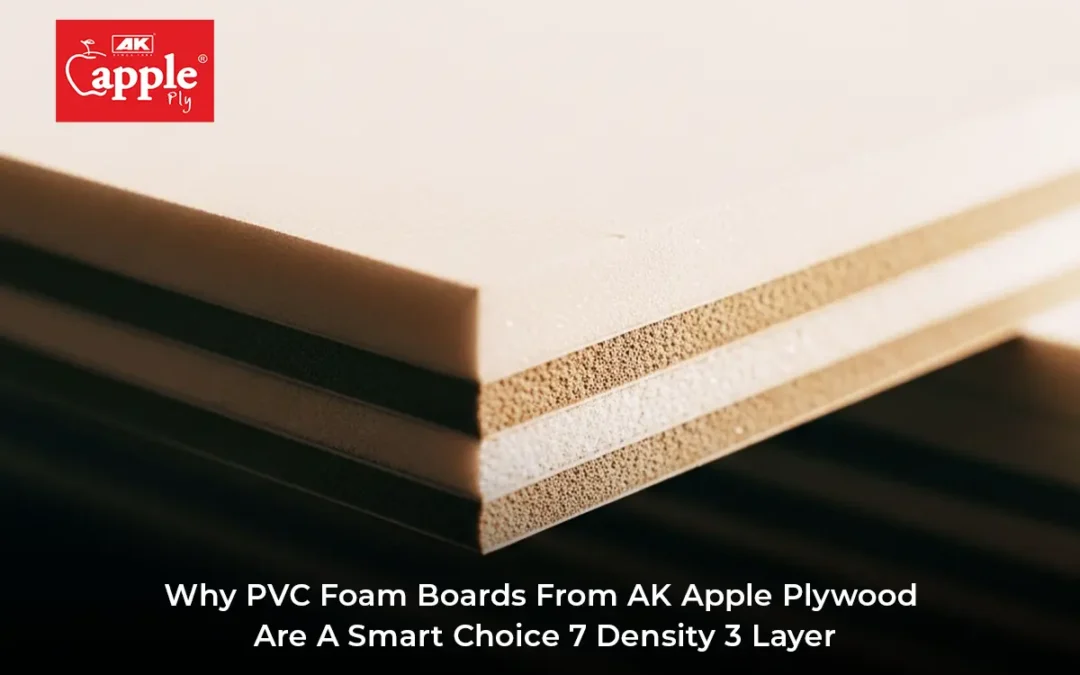
Most people assume builders only work with plywood. What they don’t see is the range of specialised materials that go into modern interiors, materials designed for moisture resistance, fire safety, longevity, and precision. One such material quietly transforming interiors is the PVC foam board.
PVC foam boards don’t swell, warp, or demand constant maintenance, making it a preferred choice for applications where performance matters as much as appearance. With advanced variants like the 7 density PVC foam board, manufacturers can achieve higher strength, better screw-holding capacity, and long-lasting stability, even in demanding environments.
At AK Apple Plywood, this understanding of material science goes beyond plywood. Backed by decades of manufacturing expertise, the brand delivers PVC foam core boards that meet modern construction needs, proving that what goes into great interiors is far more advanced than most people imagine.
What are the key benefits of using PVC foam boards
Let’s break down the key benefits of using PVC foam core boards:
- Lightweight
Thanks to their internal air pockets, similar to styrofoam, PVC foam boards are significantly lighter than wood or traditional solid panels. This makes handling, transportation, and installation much easier, reducing labor costs and effort. - Durable and Moisture-Resistant
The air pockets inside the board are tightly sealed, preventing water absorption. This makes PVC foam boards resistant to moisture, mold, and rot—an advantage especially in humid environments. The 7 density board variant provides added structural integrity, making it suitable for furniture applications that require strength and longevity. - Fire-Resistant
PVC foam boards are inherently self-extinguishing, offering an extra layer of safety for interiors. Some boards include fire-resistant additives during manufacturing, which ensures that in case of ignition, the material melts rather than spreads flames, reducing fire hazards. - Easy to Cut and Shape
The cellular core structure of PVC foam boards allows them to be easily cut, drilled, or shaped using standard tools. This flexibility supports custom furniture designs, signage, and other creative applications without compromising the material’s strength. - Smooth Surface for Finishing
The extrusion and calendering processes used in manufacturing these boards produce ultra-smooth surfaces. This makes them perfect for high-quality printing, painting, laminating, and veneering, ensuring flawless finishes every time. - Eco-Friendly and Low Maintenance
Unlike wood, PVC foam core boards do not require regular polishing or painting to maintain their appearance. They are easy to clean, and many variants are recyclable, contributing to more sustainable building and furniture solutions.
AK Apple Plywood’s Range of PVC Foam Boards
AK Group has developed a comprehensive portfolio of PVC foam core board products, catering to both standard and heavy-duty applications:
- 3 Layer PVC Foam Board
- HD Density PVC Foam Board (700 kg/m³) – commonly referred to as a 7-density PVC foam board, ideal for high load-bearing furniture applications
- AK app-ROCKstrong™ – HD PVC Foam Board (600 kg/m³)
- AK app-strong™ – PVC Foam Board (500 kg/m³)
- AK app-ROCKstrong™ – PVC Foam Board (550 kg/m³)
This wide density range allows professionals to select the right PVC foam board based on structural needs, durability expectations, and design intent.
Also read: PVC Foam Boards: A Durable Solution for Interiors
PVC Foam Board for Furniture: Ideal Applications
- Used for modular home and office furniture such as wardrobes, cabinets, and workstations
- Ideal for kitchen cabinets and bathroom vanities due to moisture resistance
- Suitable for TV units, wall panels, headboards, and decorative furniture
- Commonly used in home interiors, including partitions and false ceilings
- Used for external and internal wall panels in residential and commercial spaces
- Applied in signboards, POP displays, and outdoor advertising kiosks
- Used in exhibition stalls, retail fixtures, and display units
- Suitable for vehicle interiors like the ceilings of cars, buses, and trains
- Used in construction applications, garage doors, and utility enclosures
PVC Foam Board vs Traditional Plywood: A Smarter Alternative
When choosing materials for furniture and interiors, the debate often comes down to PVC foam board vs traditional plywood. While plywood has been used for decades, evolving requirements around durability, moisture resistance, and maintenance have made PVC foam board a more practical alternative for modern applications.
Key Differences at a Glance
| Parameter | PVC Foam Board | Traditional Plywood |
| Material Composition | Made entirely from PVC (plastic-based) | Made from wood veneers bonded with adhesives |
| Moisture Resistance | 100% water-resistant; does not swell or warp | Absorbs moisture; prone to swelling and delamination |
| Termite & Borer Resistance | Completely termite-proof | Requires chemical treatment; still vulnerable |
| Durability | Long-lasting and dimensionally stable | Strength reduces over time, especially in humid areas |
| Weight | Lightweight and easy to handle | Heavier and harder to install |
| Fire Behaviour | Self-extinguishing; slows flame spread | Combustible material |
| Surface Finish | Smooth and uniform; ideal for laminates and paint | Surface variations due to wood grain |
| Maintenance | Low maintenance; no polishing or treatment needed | Requires regular care and protection |
| Environmental Exposure | Performs well in wet and humid environments | Best suited for dry interiors only |
The Right PVC Foam Board Is Just One Smart Decision Away
There are many options in the market, but choosing the right PVC foam board is a decision you can’t afford to get wrong. The wrong choice can lead to durability issues, poor performance, and higher long-term costs.
Always consider the application, required strength, and board quality before finalising. A high-quality PVC foam board ensures better finish, longer life, and minimal maintenance, especially for furniture exposed to moisture or heavy use.
Choose wisely today to avoid costly replacements tomorrow.
Explore AK Apple Plywood’s range of premium PVC foam boards and invest in furniture that lasts.
FAQs:
1. Is PVC foam board better than plywood for furniture?
In many applications, yes. It is water-resistant, termite-proof, and requires far less maintenance than traditional plywood. It performs especially well in kitchens, bathrooms, and humid environments where plywood is prone to swelling or damage.
2. How long does PVC foam board last?
A high-quality PVC foam board can last 15–25 years or more when used correctly. Its resistance to moisture, corrosion, and pests ensures long-term durability with minimal upkeep.
3. Is PVC foam board suitable for modular furniture?
Yes, they are widely used in modular furniture due to their lightweight structure, consistent density, and smooth surface finish, making them ideal for modern furniture designs.
4. Can PVC foam board be used in kitchens and bathrooms?
Absolutely. Since PVC foam board does not absorb water, it is an excellent choice for kitchen cabinets, bathroom vanities, and under-sink units.
5. Does PVC foam board require special maintenance?
No, they are low-maintenance and easy to clean. Unlike plywood, they do not need polishing, chemical treatments, or regular protection against termites or moisture.